A polysynth from Riga that thinks for itself
The RMIF TI-3 and TI-5 are polyphonic synthesizers built in Riga in the eighties. Their brain is a K580IK80 CPU (an Intel 8080 equivalent) with its own firmware: it scans the keyboard and panel, assigns voices and runs the envelopes, arpeggiator and sequencer.
In RMIF TI-10 this firmware is not rewritten: it runs on a cycle-accurate CPU emulator together with the timer oscillators, switch and LED matrices, the knob ADC and the DAC. On top of it sits the analog part of the voice: DCO shapers, a ladder filter and an amplifier. That is why the tones, envelopes and even the arpeggiator feel like the real instrument.
The original and the modern section
Original TI
TI-5 or TI-3 firmware
- Eight voices, timer-based oscillators, wave shapers
- Ladder filter, filter and amplitude envelopes
- Built-in TI-5 arpeggiator and sequencer
- Factory TI-5 and TI-3 banks
- Adjustable CPU clock and coupling capacitor
TI-10 section
What the original did not have
- An extra Juno-style oscillator: sub wave, octave, low cut — routed through the TI filter and amplifier
- 8, 16, 24 or 32 voices and stereo spread
- Chorus with four modes including a three-phase ensemble
- Tempo-synced delay, reverb and EQ
- Output saturator: Tape, Tube and TI Output
- Arpeggiator with 16 patterns and 16 rhythms, synced to the host
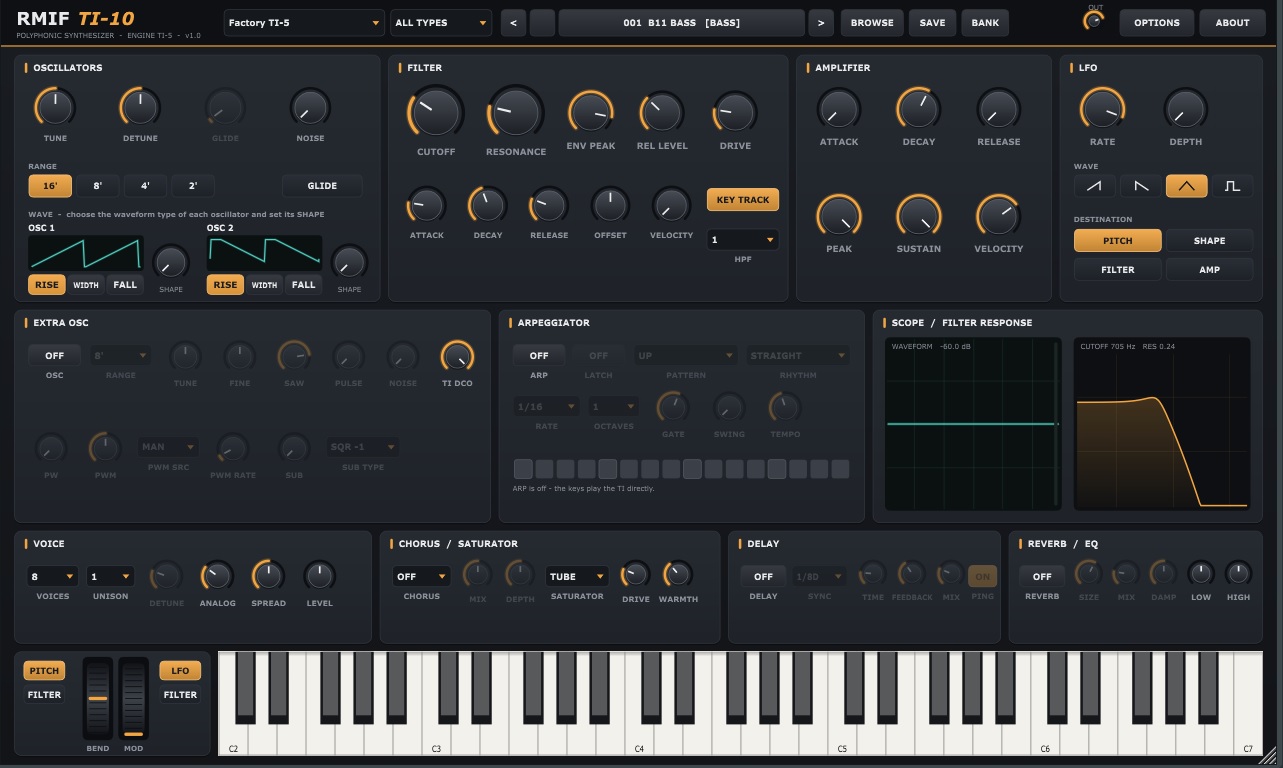
A practical panel instead of a hardware copy
- Panelgrouped by function
- Controls are grouped by purpose, buttons that only the firmware needed are gone, and inactive controls are dimmed. Every control has a tooltip.
- Feedbackscope and filter
- A live oscilloscope, a filter response graph and a Wave Edit section with a waveform preview for each oscillator.
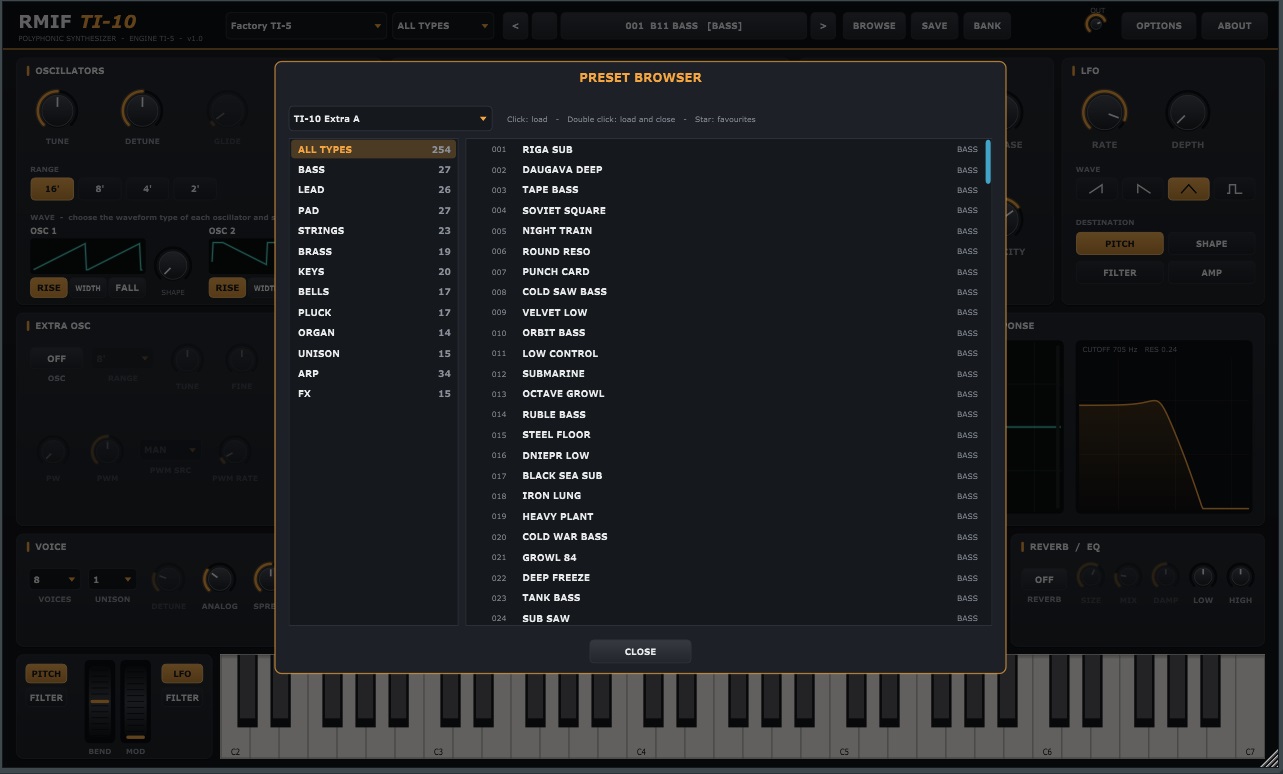
- Presetsbrowser and favourites
- A preset browser with banks and categories, a virtual Favourites bank and fast switching without hang-ups.
- Playingwheels and velocity
- A virtual keyboard with pitch and mod wheels, velocity response and an adjustable pitch bend range (±1…24 semitones).
892 presets
The Factory TI-5 and Factory TI-3 banks use only what the original instrument could do. The TI-10 Extra A and Extra B banks use the modern section: the extra oscillator, effects and arpeggiator. Presets are sorted into 12 categories.
What RMIF TI-10 looks like
Download RMIF TI-10
Choose the build for your system.